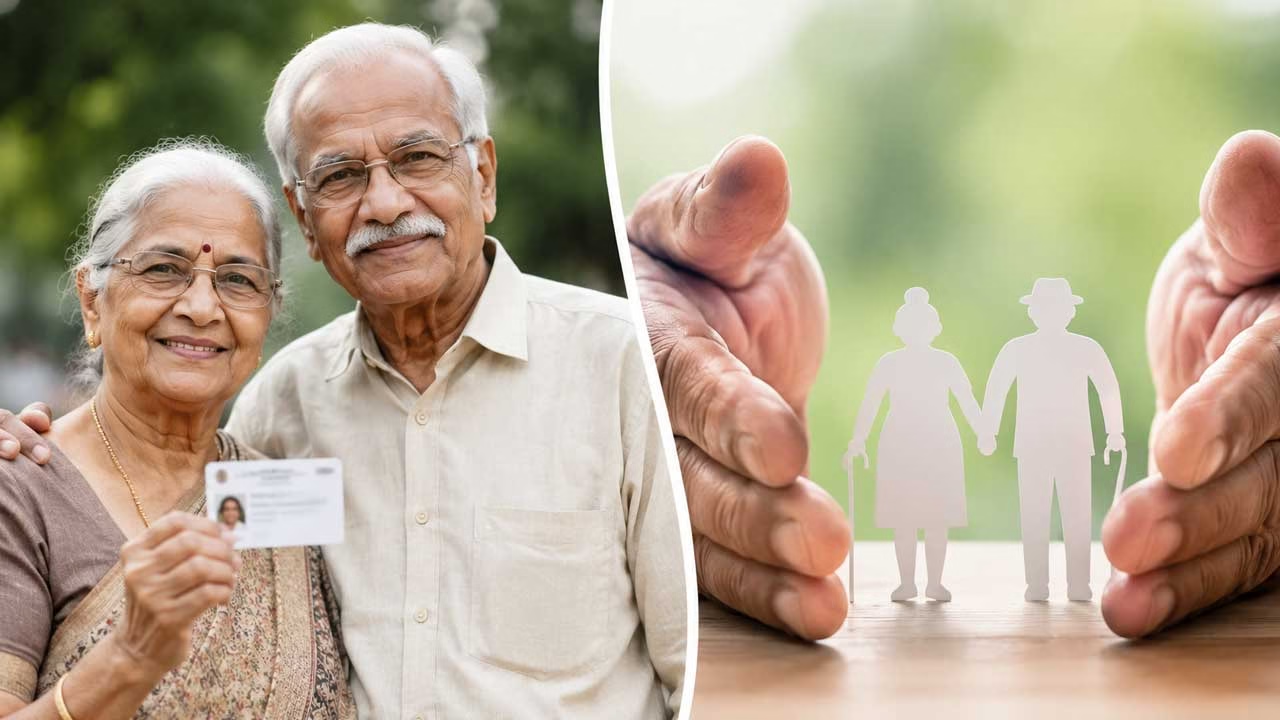
Many older people in India first hear about a senior citizen card not through government announcements, but during practical moments in life. It may happen at a railway counter, inside a hospital, or while applying for local welfare support. What appears to be a simple identity card often becomes a document that quietly simplifies routine interactions for elderly citizens who otherwise struggle with repeated age verification.
Understanding the Purpose Beyond Discounts
A common misunderstanding is that the senior citizen card exists only for travel concessions or financial benefits. In reality, the card also acts as a recognized age-based identity document that can support access to welfare schemes, healthcare services, and local administrative assistance. In several states, authorities use it as part of elderly welfare records to identify citizens who may require support services.
Why State-Level Differences Matter
One of the less discussed aspects of applying for a senior citizen card in India is that the process is not completely uniform across the country. Some states issue dedicated senior citizen identity cards through social welfare departments, while others integrate elderly verification into broader digital citizen service systems. Because of this, applicants often become confused when comparing procedures followed in different states.
The Shift Toward Digital Applications
In many regions, the application process has gradually moved online, reducing the need for elderly citizens to visit multiple government offices repeatedly. Several state portals now allow applicants or family members to upload proof of age, address documents, and photographs digitally before physical verification takes place. This change has become especially important for senior citizens who face mobility challenges or live far from district offices.
Documents That Usually Create Delays
The most common obstacle in the application process is not eligibility but document mismatch. Older citizens frequently possess records created decades ago, and differences in spelling, date formats, or address details can complicate verification. In some cases, age proof in school certificates may not match Aadhaar or voter identification records, leading to avoidable delays during approval.
The Role of Family Members in the Process
Interestingly, many applications today are completed not by senior citizens themselves but by their children or relatives. Digital forms, scanned document uploads, and online tracking systems can sometimes feel unfamiliar to elderly applicants. Family involvement has therefore become an important part of the process, especially in urban areas where applications are increasingly tied to digital governance systems.
Urban and Rural Experiences Are Often Different
The experience of applying for a senior citizen card can vary significantly between cities and rural regions. Urban applicants may benefit from faster online processing and easier access to service centers, while rural citizens often depend more heavily on local administrative officers for guidance. In villages, awareness about the importance of the card itself is sometimes still limited, particularly among elderly individuals who rarely interact with formal digital systems.
Why the Card Has Gained More Relevance in Recent Years
India’s aging population has quietly changed the way governments and institutions approach elderly welfare. Hospitals, transport systems, banks, and local authorities increasingly recognize the need for dedicated identification for senior citizens. As public services become more digitized, age-linked documentation is also becoming more important for maintaining accurate welfare databases and simplifying verification processes.
Privacy and Identity Concerns Among Elderly Applicants
Another emerging issue is the hesitation some older citizens feel about sharing personal data online. Many elderly applicants are unfamiliar with digital verification systems and remain cautious about uploading identification documents through internet portals. This concern has grown alongside increasing awareness about online fraud, making trust and guidance an important part of the application experience.
More Than a Welfare Document
For some senior citizens, receiving the card carries emotional value beyond administrative convenience. It represents formal recognition of a stage in life that is often overlooked in fast-moving urban environments. Elderly applicants sometimes describe the process as a reminder that public systems still acknowledge their presence and needs within society.
The Importance of Accurate Local Information
Because procedures may change between states and districts, applicants benefit most from checking the latest instructions issued by local welfare departments before beginning the process. Eligibility age, verification methods, and application modes can vary depending on regional administrative policies. Relying on outdated assumptions or second-hand advice often creates unnecessary confusion during submission.
Application Form
Sign the application form and submit it to the nearest Tahsildar office along with the required documents, including a ration card, address proof, age proof, and passport-size photograph.
A Growing Part of India’s Digital Public Services
The increasing use of senior citizen cards reflects a broader transformation happening across India’s public service systems. Identity verification, welfare access, and citizen records are becoming more digitally connected than before. For elderly citizens, adapting to these changes may sometimes feel difficult, but the senior citizen card is gradually becoming one of the simplest ways to remain visible within an increasingly digital administrative environment.