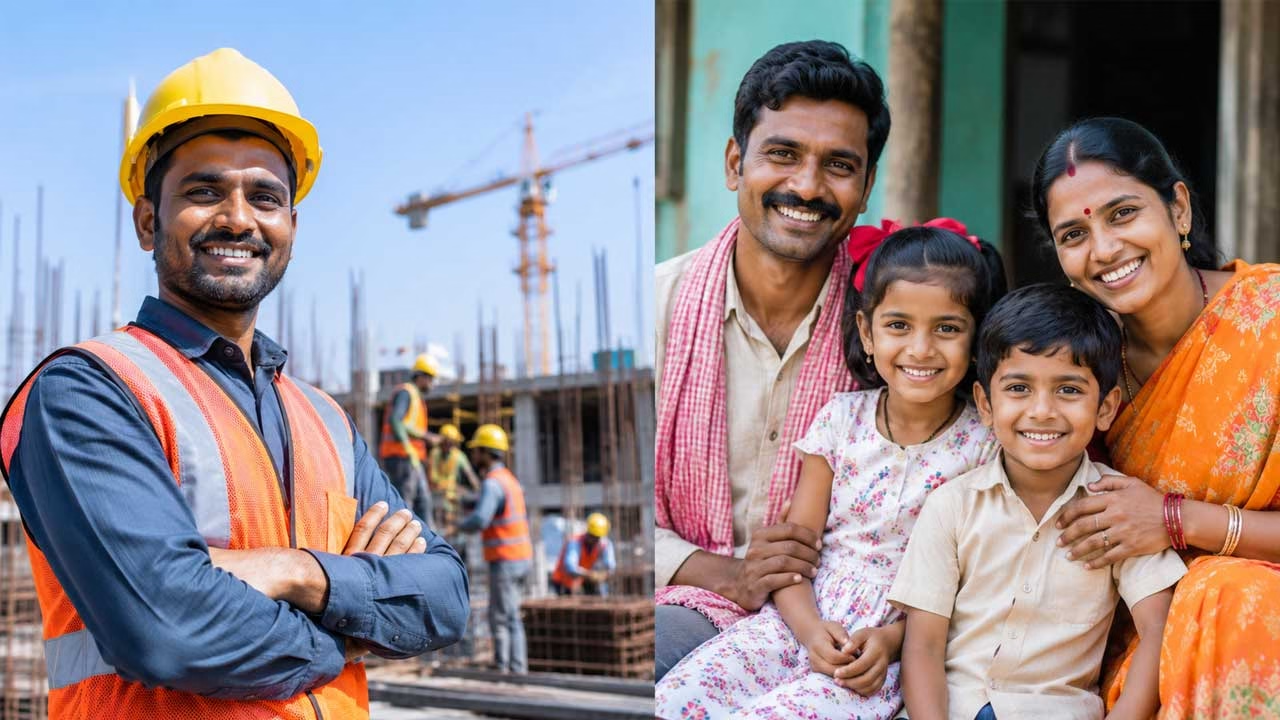
A construction worker’s income can be affected by an accident, illness, retirement or a sudden family expense, which is why Karnataka’s labour-card system is more than an identity document. Eligible building and construction workers registered with the Karnataka Building and Other Construction Workers Welfare Board can access a range of welfare and social-security schemes covering pension, disability, medical treatment, education, housing, marriage, maternity and other needs.
Who Can Apply for a Karnataka Labour Card?
The registration is meant for eligible building and construction workers. Under the BOCW framework, a worker must generally be at least 18 years old and below 60 years of age and should have worked in building or other construction activities for at least 90 days during the preceding 12 months. Registration as a beneficiary is important because most of the welfare schemes discussed below are available only after the worker has been registered with the Board.
How to Apply for a Labour Card Online in Karnataka?
The online registration process begins through the Karnataka Building and Other Construction Workers Welfare Board’s online system. A new applicant can select the option to register as a new construction worker, provide the mobile number used for verification and complete the OTP process. The registration section then requires the worker to enter personal, address, family, employment and bank details and provide the required proof of construction work and other documents before submitting the application for verification.
Documents and What Happens After Registration?
Applicants should keep their Aadhaar details, age or identity proof, bank-account information, photograph and proof of having completed the required construction work ready. Employment or 90-day work certification may be required depending on the application. After submitting the registration, the information is verified before beneficiary status is approved. Once registration is approved, the worker can log in and access the applicable welfare schemes instead of treating the labour card itself as an automatic payment approval.
Pension Benefit for Registered Construction Workers
Pension is one of the most important long-term benefits under the labour-card system. The scheme information supplied for the Karnataka Board states that a registered beneficiary who completes three years as a beneficiary can receive ₹1,000 per month as pension, subject to the applicable conditions. This means simply obtaining a labour card does not immediately make a worker eligible for pension; maintaining beneficiary status and completing the required period are important. Workers should also verify the currently sanctioned pension amount when submitting a pension claim because different published records now show revised figures.
Disability Pension and Accident Assistance
The welfare framework also provides support when a registered construction worker suffers disability. The scheme information lists disability pension of ₹1,000 per month together with ex-gratia assistance of up to ₹2 lakh, depending on the extent of disability. Separately, the accident assistance provision covers accidental death or permanent disability, with assistance of up to ₹5 lakh under the cited scheme. These benefits are subject to their respective eligibility conditions, and the same incident should not automatically be assumed to qualify for every accident-related benefit.
Medical Assistance and Major-Ailment Treatment
Healthcare is another major part of the welfare programme. Under Karmika Arogya Bhagya, the published scheme information provides ₹300 per day of hospitalisation, up to ₹10,000, subject to the applicable conditions and hospitalisation requirements. Karmika Chikitsa Bhagya separately provides assistance of up to ₹2 lakh for specified major ailments. The listed treatments include serious conditions and procedures involving the heart, kidneys, cancer, eyes, paralysis, orthopaedics, brain, dialysis, ENT, neurosurgery and several other medical conditions, subject to the prescribed rules and applicable rates.
Education Assistance for Two Children
Kalike Bhagya provides educational assistance for up to two children of a registered construction worker. The published schedule includes assistance of ₹2,000 after passing Classes 1 to 3, ₹3,000 for Classes 4 to 6, ₹4,000 for Classes 7 and 8, ₹6,000 for Classes 9 and 10 and first PUC, and ₹8,000 for second PUC. For ITI or eligible professional diploma courses, the listed assistance is ₹7,000 for each year of passing, while degree courses receive ₹10,000 for each year. Higher education support includes ₹20,000 for entry into postgraduate study followed by ₹10,000 for eligible subsequent years, while engineering and MBBS courses have separate entry and yearly assistance provisions. Doctoral research assistance is also included under the published schedule.
Merit Assistance for Students
Students who achieve strong academic results can receive additional merit assistance under the published scheme. The listed amounts are ₹5,000 for scoring above 75% in SSLC or equivalent, ₹7,000 for PUC, ₹10,000 for a degree and ₹15,000 for a master’s degree. This is separate from the regular educational-assistance schedule, so eligible families should check whether the student satisfies the conditions for both forms of support before applying.
Housing, Training and Maternity Benefits
The welfare programme also reaches beyond education and healthcare. Karmika Gruha Bhagya provides ₹2 lakh in housing assistance under the cited scheme. The Shrama Samarthya toolkit-cum-training programme provides assistance of up to ₹20,000, supporting tools and training for eligible workers. Under Thayi Lakshmi Bond, maternity assistance is listed as ₹30,000 for a female child and ₹20,000 for a male child, subject to the scheme conditions and limited to the first two children.
Marriage, Funeral and Child Support
Marriage assistance is another benefit available through the Board, with the supplied scheme information listing ₹50,000 for the marriage of the beneficiary or up to two children. Funeral assistance includes ₹4,000 towards funeral expenses and ₹50,000 as ex-gratia in the event of the death of a registered construction worker. Thayi Magu Sahaya Hastha provides ₹6,000, calculated at ₹500 per month, towards preschool education and nutritional support for the child of an eligible registered woman construction worker.
LPG and Transport-Related Benefits
Some benefits are provided as services rather than direct cash payments. Karmika Anila Bhagya covers an LPG connection for an eligible registered construction worker’s family, including a two-burner stove and refill as specified under the scheme. The Board’s welfare provisions also include assistance for a free BMTC bus pass for eligible registered workers travelling in Bengaluru and a student bus-pass facility for eligible children travelling through KSRTC services. Availability depends on the applicable scheme conditions.
How to Apply for Welfare Schemes After Getting the Labour Card
After the labour-card registration is approved, the worker can log in to the Board’s online system and access the available schemes section. The worker should select the relevant benefit, enter the requested information, upload the documents required for that particular scheme and submit the claim. For example, a pension application may require beneficiary records and a living certificate, while maternity, medical or education claims require documents specific to those circumstances. Karmika Seva Kendras can also help workers who need assistance with registration, welfare applications, claims or related services.
Apply Now
Keep the Registration Active and Check the Correct Benefit
The most important point is that a Karnataka labour card does not mean that every worker automatically receives ₹36,000 or any other fixed amount. The card provides access to a welfare framework in which each benefit has its own eligibility rules, documentation and approval process. Workers should keep their registration details updated, complete renewals when required and apply only for schemes for which they qualify. Before submitting a claim, checking the current amount and conditions through the Karnataka Building and Other Construction Workers Welfare Board or its authorised service centres is the safest way to avoid relying on outdated social-media information.