There was a time when photographs acted as proof that a moment existed. Today, with Generative AI, images are no longer limited to what happened—they can represent what connects. This shift is most visible in the emerging concept of Timeline portraits, where multiple phases of a human life are brought together into a single, unified visual narrative.
This is not nostalgia recreated through editing. It is a form of computational storytelling, where models interpret identity across time and reconstruct it with precision. The challenge is not simply generating an image, but maintaining continuity between two versions of the same person while preserving emotional authenticity. At its core, this practice blends Generative AI Workflows with advanced Prompt Engineering for Professionals, producing results that fall under the category of High-Fidelity Synthetic Media. But the real significance lies in how these portraits redefine what an image can represent.
When AI Stops “Improving” Faces
One of the most important changes in modern AI image generation is philosophical rather than technical. Early systems attempted to “fix” faces. Skin was softened, features were standardized, and expressions were subtly altered to match a generic ideal. The output looked clean, but it often felt detached from reality. The newer approach rejects this entirely. Instead of enhancement, the goal is preservation. The system is guided to respect the original structure of the face, including its irregularities. Slight asymmetry in the eyes, natural texture in the skin, and unpolished expressions are treated as essential data rather than noise.
This shift has led to a new standard in Synthetic Media—one where realism is measured not by perfection, but by believability. A high-quality output is one where the viewer does not question whether the person looks “better,” but whether the person looks the same. This also introduces a deeper ethical layer. When generating images of real individuals, altering their features beyond recognition can distort identity. Maintaining Facial Recognition Integrity ensures that the generated result remains anchored to the individual’s true appearance, even when placed in a synthetic context.
In this sense, the role of the creator changes. The task is no longer to direct transformation, but to enforce boundaries. Precision comes from knowing what must remain untouched.
A Frame That Holds Two Lives
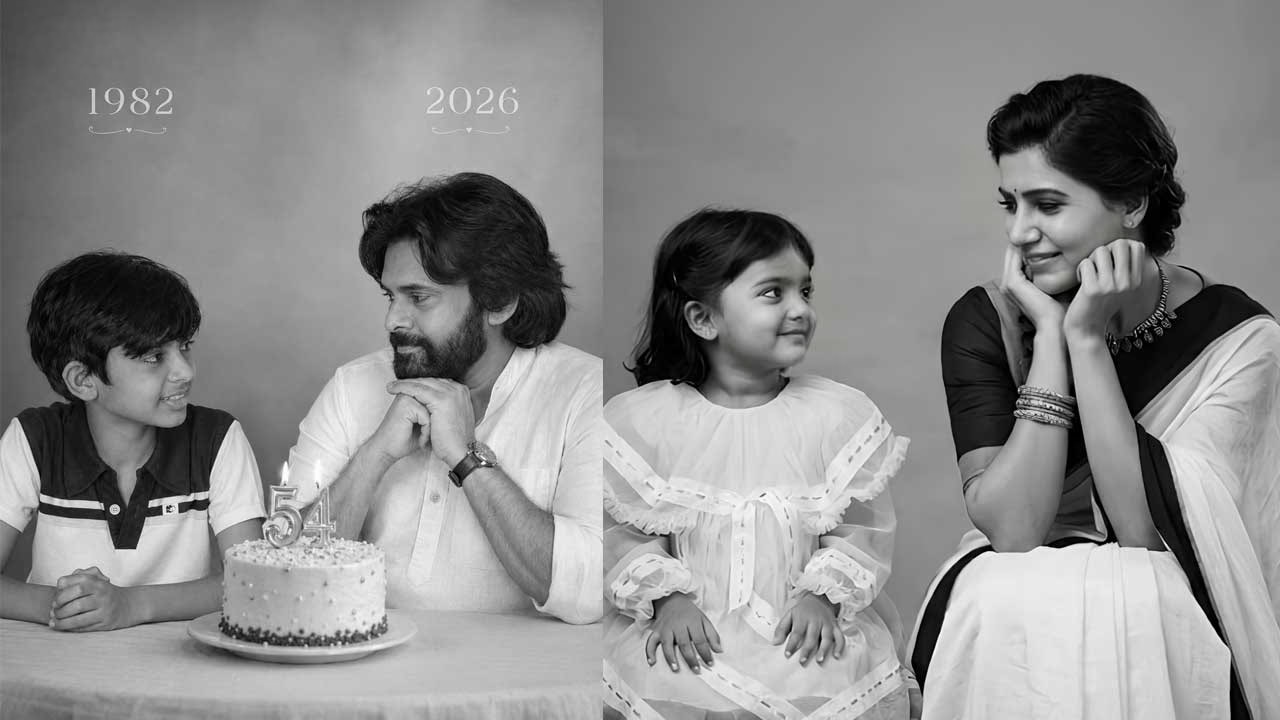
A Timeline portrait typically brings together two distinct temporal states. One might show a childhood version of a subject, while the other presents their present-day self. What matters is not just the inclusion of both images, but how they interact. The younger version often carries an openness that is instinctive and unfiltered. The older version introduces stillness, shaped by experience. When placed in the same visual environment, these two states begin to form a relationship. This is where Chronological Compositing becomes more than a technical process. It becomes a narrative structure.
The direction of gaze plays a subtle but powerful role. When the adult looks toward the child, the image suggests reflection. When the child looks forward, it implies anticipation. Together, they create a loop that feels almost conversational, even though no words are present.
This is a form of Visual Communication that operates below the surface. The viewer does not need instructions to understand what is happening. The emotional connection emerges naturally, making the experience intuitive. In design terms, this can be seen as an evolution of Emotional UI/UX. Instead of guiding interaction through buttons or layouts, the image itself becomes the interface. It directs attention, evokes memory, and invites interpretation without any explicit structure.
Structuring the Image Before It Exists
The quality of a Timeline portrait is determined long before the image is generated. It begins with how the instructions are constructed. A professional prompt does not describe an image loosely. It defines a controlled environment. Composition, lighting, subject behavior, and constraints must all be specified in a way that reduces ambiguity.
The decision to use a 4:5 aspect ratio is a good example of this level of control. This format naturally supports portrait-focused compositions, allowing both subjects to exist comfortably within the frame. It also mirrors how viewers are accustomed to seeing high-quality portrait photography, making the result feel familiar and grounded.
The use of black and white is another strategic choice. By removing color, the image eliminates distractions and shifts focus toward structure and emotion. However, achieving a cinematic result requires more than desaturation. The tonal range must be carefully balanced so that highlights remain soft and shadows retain depth.
Lighting is where much of the realism is established. A soft studio setup ensures that both versions of the subject share the same visual environment. This consistency is essential for making the composition believable. Without it, the image risks feeling like a collage rather than a unified scene.
Equally important are the constraints placed on the model. Instructions that prevent smoothing or beautification force the system to retain original features. This is what separates a high-fidelity output from a stylized one. The image begins to resemble something captured through a lens rather than generated by an algorithm.
What Happens Under the Hood
While the final image may appear seamless, the process behind it is highly complex. Most modern systems rely on Latent Diffusion, where an image is gradually formed through iterative refinement. Each step brings the output closer to the desired structure, guided by the prompt.
When dealing with Timeline portraits, the complexity increases. The system must reconcile differences between two source images—differences in age, lighting, and even camera quality—while maintaining a consistent identity.
This requires careful alignment of features. The spacing between eyes, the structure of the jawline, and other defining characteristics must remain stable across both versions. Any inconsistency can break the illusion.
Rendering such detail at high resolution also demands significant computational resources. High-fidelity outputs require enough processing power to handle fine textures and subtle gradients without introducing artifacts. This is why GPU-based environments are often used for professional workflows.
Different tools approach this process in slightly different ways. Platforms like Midjourney, DALL-E 3, and Adobe Firefly each interpret prompts through their own internal models. Understanding how each system responds allows for more precise control over the final output.
Over time, creators develop an intuition for how small changes in phrasing can influence results. This is what elevates prompt engineering from a basic skill to a professional discipline.
The Prompt as a Blueprint
A Timeline portrait does not emerge from experimentation alone. It is built from a clearly defined set of instructions that guide the model step by step.
Prompt
Using the images I’m going to upload to create a soft, emotional black and white art. Let the formation be as follows: On the left: a child version of me (from a childhood photo) looking with an innocent smile to the right, with 2006 written above it. On the right: A present version of me (from a recent photo) sits with her hands under her chin and looks at the child with a calm smile wwith 2026″ written above her.
Studio background: plain and soft (studio background)
The lighting: Soft, cinematic, warm
(even a black-and-white photo) Style: Professional, minimal, emotional photography, focusing on feelings and visual communication between the two versions. Make the picture look so real like a real photoshoot. Strictly Keep my original features without changing. photo size 4:5
Download All Prompts
The strength of this prompt lies in its structure. It does not rely on vague descriptions. Every element is defined with intent, from spatial arrangement to emotional tone. By the time the model begins generating the image, most of the creative decisions have already been made. The system’s role is not to invent, but to execute.