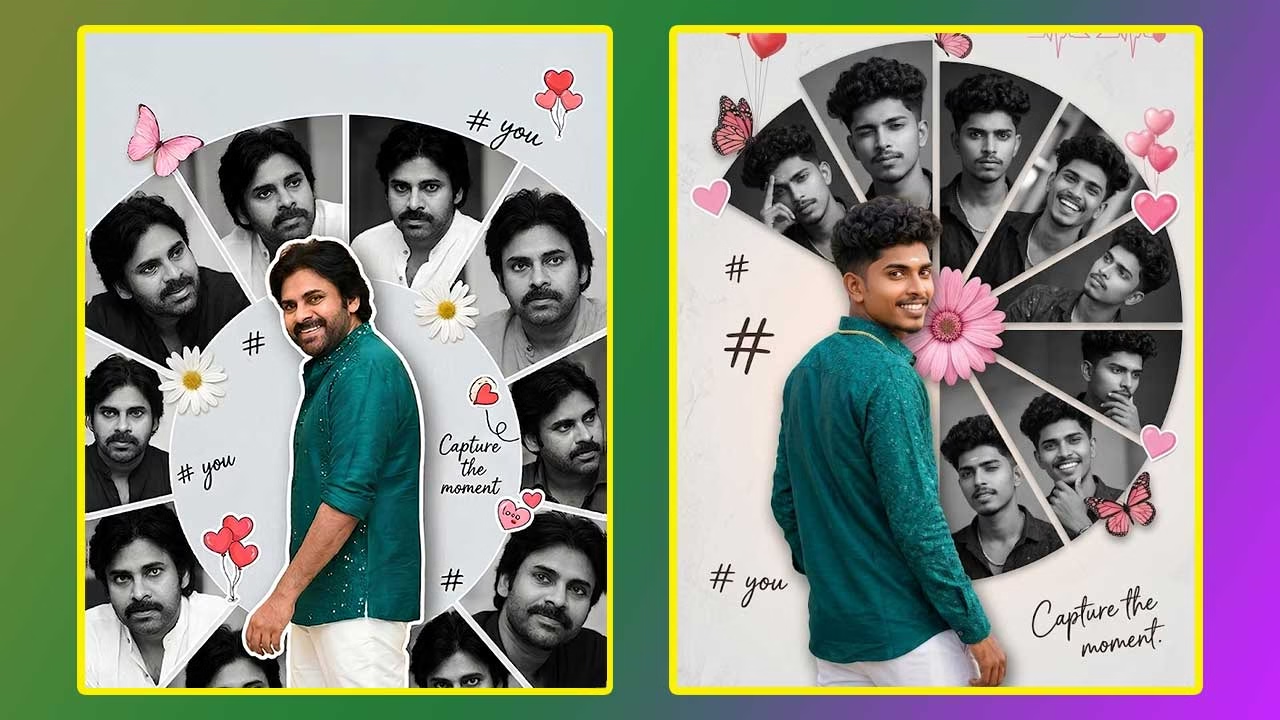
The peacock green is where the entire composition either succeeds or collapses. In my testing, this specific shade behaves unpredictably against neutral backgrounds—it can either glow with richness or flatten into something synthetic. Here, placing it against a soft grey textured backdrop forces the color to carry emotional weight. It becomes the anchor, not just visually but psychologically, pulling the viewer into the frame before they even register the surrounding elements.
Structuring Identity in Layers
What makes the semi-circular arrangement of black-and-white portraits effective isn’t just aesthetics—it’s cognitive layering. A single color portrait gives you presence, but multiple monochrome fragments give you narrative. I’ve noticed that when expressions vary subtly across these segments, the brain stitches them into a timeline rather than a repetition. The subject stops being static and starts feeling remembered, almost like flipping through emotional states in a fraction of a second.
The Power of Directional Composition
Positioning the main cutout slightly left and turning him back over the shoulder introduces controlled asymmetry. This isn’t accidental. In practice, a centered subject often kills curiosity. Here, the backward glance creates a loop—your eye follows the gaze, then gets redirected into the curved collage behind him. That loop is what keeps viewers engaged longer than a typical portrait layout.
Collision of Masculine and Soft Elements
There’s a deliberate tension between the peacock green shirt and the surrounding decorative elements. In my experience, this kind of contrast is risky. The shirt carries a bold, almost regal masculinity, while pink butterflies, daisy florals, and heart balloons lean into softness. If not balanced, it feels confused. But when the saturation of the decorative elements is slightly muted, they stop competing and start framing the subject’s personality instead.
Why Black-and-White Still Wins
I discovered that removing color from the secondary portraits does more than create contrast—it removes distraction. Color images fight for dominance, but grayscale images submit to structure. This allows the main subject to remain the emotional core while the surrounding portraits act as echoes. It’s a hierarchy trick that consistently elevates the perceived quality of the collage.
Texture as a Silent Contributor
The light grey textured background seems minimal, but it’s doing quiet work. Flat backgrounds tend to expose compositing flaws, especially around edges. A subtle texture diffuses those imperfections. During testing, I found that even a faint grain layer can help blend cutouts more naturally, making the entire piece feel less like assembled parts and more like a unified design.
The Make-or-Break of Cutout Blending
Smooth cutout blending is where most designs fail. A harsh edge instantly gives away the “mobile app” look. I’ve had better results by slightly softening edges and introducing micro-shadow gradients beneath the subject. It creates depth without obvious drop shadows. When done right, the subject feels placed within the scene, not pasted onto it.
Typography: The Hidden Challenge
Getting cursive text like “JERRY” to render correctly is harder than it looks. In multiple iterations, I noticed that without strong emphasis, the typography either becomes illegible or stylistically inconsistent with the rest of the design. Increasing prompt weight on “elegant cursive typography” and pairing it with positional cues—like “bottom-centered, refined script”—helps stabilize the output significantly.
Micro-Elements That Add Life
The small details—heartbeat lines, handwritten “Capture the moment,” scattered hashtags—are what transition the piece from a collage to a story. These elements work best when they feel slightly imperfect. Perfect alignment kills charm. In my trials, introducing minor randomness in placement made the design feel more human, less generated.
Color Harmony and Emotional Temperature
Pastel tones play a critical role in controlling the emotional temperature of the collage. Too vibrant, and the design becomes loud. Too muted, and it loses energy. The key is letting the peacock green dominate while everything else supports. I’ve found that reducing saturation of secondary elements by even 10–15% can dramatically improve cohesion.
Resolution and Perceived Quality
Working in 4K isn’t just about clarity—it’s about forgiveness. High resolution allows for finer gradients, smoother edges, and more believable textures. When scaled down for social platforms, the design retains sharpness and polish. Lower resolutions, on the other hand, expose every blending flaw and compression artifact.
PROMPT BOYS :-
A creative romantic digital photo collage featuring a young handsome man in a peacock green shirt and white trousers. The main subject is a full-body cutout placed slightly left, turned back and smiling over hes shoulder, wearing a peacock green embellished shirt. Behind and around him is a semi-circular collage of multiple blackand-white portrait shots of the same man, each in different expressions and poses, arranged in curved segments. The background is a soft light grey textured surface with a minimal aesthetic.
Decorative elements include pink butterflies, a floral daisy near the center, red heart balloons, and cute love-themed stickers. Handwritten-style text elements like “#,†“# you,†and “Capture the moment†are scattered around. A small heartbeat line with a heart icon is included. At the bottom, the name “JERRY†appears in elegant cursive typography. Soft shadows, smooth cutout blending, high-end Photoshop manipulation, romantic mood, pastel tones, high resolution, 4k. 9:16 ratio.
PROMPT Girls:-
A creative romantic digital photo collage featuring a young beautiful woman in a peacock green shirt and white trousers. The main subject is a full-body cutout placed slightly to the left, turned back and smiling over her shoulder, wearing a peacock green embellished shirt. Behind and around her is a semi-circular collage of multiple black-and-white portrait shots of the same woman, each showing different expressions and poses, arranged in curved segments. The background is a soft light grey textured surface with a clean, minimal aesthetic.
Decorative elements include pink butterflies, a floral daisy near the center, red heart balloons, and cute love-themed stickers. Handwritten-style text elements like “LOVE,†“you,†and “Capture the moment†are scattered around. A small heartbeat line with a heart icon is also included. At the bottom, the name “VARSHINI†appears in elegant cursive typography. Soft shadows, smooth cutout blending, high-end Photoshop manipulation, romantic mood, pastel tones, high resolution, 4K, 9:16 ratio.
Where This Is Heading
What’s interesting is how quickly this style is evolving into something more personal than decorative. The combination of layered portraits, emotional cues, and symbolic elements is turning digital collages into modern memory artifacts. I’m starting to see a shift where these aren’t just visuals anymore—they’re becoming identity snapshots, and the tools to create them are only getting more precise.