There’s a peculiar thrill in watching a thought become something you can almost touch, especially when that thought involves placing yourself inside a moment that never actually happened. The process doesn’t begin with software or settings—it begins with intent. When you take a highly specific prompt like the one above, you are not just describing an image; you are constructing a scene with emotional weight, cultural context, and visual hierarchy. Modern AI tools have reached a stage where they don’t merely generate visuals—they interpret layered instructions, making it possible to design scenes that feel staged, directed, and almost cinematic in execution.
Understanding the Role of Structured Prompts
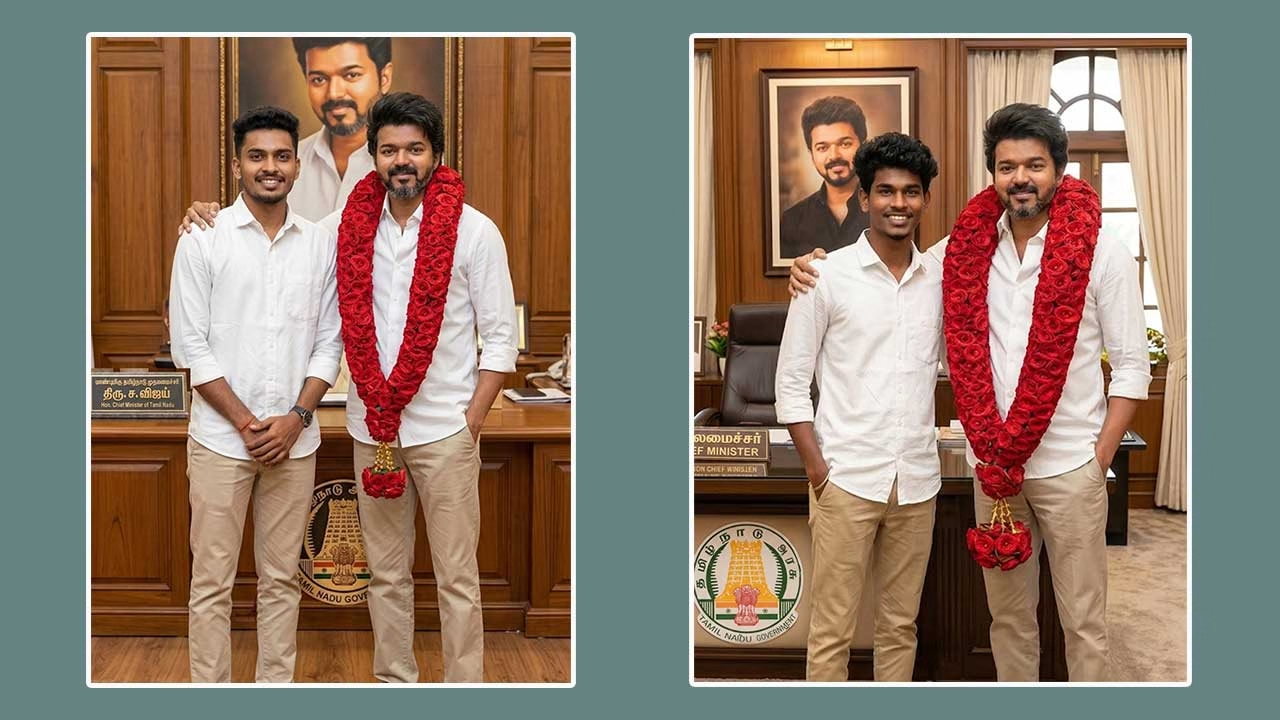
A prompt like this works because it is deeply structured. It doesn’t leave room for ambiguity. Every element, from the “medium long shot” framing to wardrobe details like “white full hand shirt” and “light kakhi pant,” contributes to how the AI builds the scene. Unlike generic prompts, this one defines posture, relationship, environment, and even symbolic elements like the garland. Professional AI tools thrive on this level of clarity. The more intentional the prompt, the closer the output aligns with the creator’s mental image.
The Importance of Character Pairing in AI Composition
One of the most technically challenging aspects of this prompt is the pairing of two individuals—your uploaded image and Vijay. AI systems must balance likeness accuracy for both faces while maintaining a natural interaction between them. This is not just about placing two faces side by side; it’s about ensuring that body language, eye direction, and physical contact feel believable. The instruction “friendly hug” becomes crucial here, guiding the AI to create a connection rather than a static composition.
Environment as a Narrative Device
The setting described—a Tamil Nadu Chief Minister’s office—is not just a background. It is a narrative anchor. It communicates authority, aspiration, and context without needing additional explanation. By specifying “indoor Tamilnadu CM office background” and including a large image on the wall, the prompt ensures depth and realism. Professional AI tools interpret such instructions by layering environmental cues, lighting consistency, and spatial arrangement to make the scene feel authentic rather than artificially assembled.
Wardrobe and Symbolism in Visual Storytelling
Clothing plays a surprisingly powerful role in AI-generated imagery. The choice of a white full-sleeve shirt and light khaki pants is not random—it evokes simplicity, leadership, and political neutrality. The addition of a large red rose garland introduces a ceremonial tone, often associated with honor and celebration. When these elements are combined, the AI doesn’t just generate outfits; it constructs a visual language that communicates status and emotion simultaneously.
Precision in Pose and Body Language
The instruction “hands fold 2 step” might seem minor, but it significantly influences the final output. Body posture defines the mood of the image. Folded hands suggest respect or acknowledgment, while the shoulder hug adds warmth and familiarity. Professional AI tools analyze these cues to create balanced compositions where gestures don’t feel forced. This is where amateur prompts often fail—they describe subjects but ignore how those subjects interact physically.
Achieving Face Accuracy with Advanced Models
The demand for “Face accuracy 100%” highlights one of the most critical aspects of AI image generation. High-end tools use advanced facial recognition and reconstruction models to maintain identity integrity. When you upload an image, the system maps facial features, proportions, and textures to ensure consistency across generated outputs. Achieving near-perfect accuracy requires not only a clear reference image but also a prompt that avoids conflicting instructions.
Aspect Ratio and Its Cinematic Impact
Specifying a 9:16 aspect ratio transforms the composition into a vertical, mobile-first format. This is particularly important for platforms like Instagram Reels or YouTube Shorts. The AI adapts the framing to ensure that both subjects remain centered and visually dominant within a taller canvas. This vertical orientation also enhances the sense of presence, making the viewer feel closer to the subjects.
The Role of Negative Instructions
An often-overlooked strength of this prompt is the line: “Don’t include any party symbol or flag.” Negative instructions are just as important as positive ones. They help the AI avoid adding unwanted elements that might otherwise appear due to contextual associations. In politically sensitive environments, this level of control ensures that the final output remains neutral and aligned with the creator’s intent.
Tool Selection: Why “Pro AI Tools” Matter
Not all AI tools are capable of handling such detailed prompts. Professional-grade platforms offer better control over composition, higher resolution outputs, and more accurate facial rendering. They also allow for iterative refinement, meaning you can tweak the prompt and regenerate outputs until the result matches your vision. This iterative process is what separates casual experimentation from professional creation.
Iteration as a Creative Strategy
Even with a well-crafted prompt, the first output is rarely perfect. The real power of AI creation lies in iteration. By adjusting small details—lighting intensity, camera angle, or facial expression—you can gradually refine the image. Each version teaches you something about how the AI interprets your instructions, allowing you to improve both the prompt and the result.
Emotional Realism in AI-Generated Scenes
What makes an AI-generated image truly compelling is not just visual accuracy but emotional believability. The friendly hug, the ceremonial garland, and the formal setting all contribute to a scene that feels meaningful. When viewers look at the final output, they shouldn’t feel like they are seeing a generated image; they should feel like they are witnessing a captured moment.
Prompt:
A medium long shot of Thalapathy Vijay recent looks and me uploaded image person, standing in CM office, both wearing a white full hand shirt hands fold 2 step, light kakhi pant, sandel breakwood. Wear the red rose flower big and bigger garland around Thalapathy Vijay neck. Thalapathy hand my shoulder friendly hug, the setting is indoor Tamilnadu CM office background Thalapathy Vijay image in wall bigger, resembling a Tamilnadu CM office. Dont include any party symbol or flag in it. Face accuracy 100%. 9:16
The Future of Personalized Visual Creation
Creating AI visuals using prompts like this represents a shift in how people engage with digital content. It’s no longer about consuming images—it’s about designing them. With the right combination of detailed prompts and professional tools, anyone can create scenes that were once impossible without extensive resources. As AI continues to evolve, this process will only become more intuitive, allowing imagination to move even closer to reality.