The evolution of generative AI has quietly transformed portraiture into a philosophical bridge between memory and imagination, where cultural identity is no longer constrained by physical reality but reinterpreted through algorithmic vision. In the context of South Indian identity, this transformation becomes especially significant. Skin tone, facial geometry, and subtle cultural aesthetics carry centuries of visual language, and when merged with fantasy elements like luminous butterflies and ethereal lighting, the result is not mere stylization but a form of digital metamorphosis that preserves heritage while expanding visual possibility.
Identity Anchoring as a Core Architectural Principle
At its core, the analyzed prompt is an exercise in identity anchoring. The directive to maintain the “exact same face and identity” is not stylistic language—it is a hard constraint that forces the generative model to prioritize facial embeddings above all other attributes. In advanced pipelines, this aligns with Enterprise Prompt Management practices, where prompts are modularized into identity, environment, lighting, and stylistic layers. The identity layer must dominate the hierarchy, ensuring that aesthetic transformations such as wardrobe changes or fantasy overlays never override biometric fidelity.
Midjourney v6: Cinematic Abstraction and Style Synthesis
When implementing this prompt in Midjourney v6, the focus shifts toward stylistic richness and cinematic composition. Midjourney excels in interpreting descriptive language such as “dreamy bloom effect” and “soft glowing particles,” producing visually compelling outputs with minimal configuration. However, its abstraction layer can sometimes weaken identity precision. To mitigate this, practitioners rely on weighted prompts and reference images, effectively reinforcing facial structure while still allowing creative expansion within the model’s latent space.
Stable Diffusion XL: Precision Control and Identity Locking
Stable Diffusion XL introduces a more controlled environment for identity preservation. Through tools like ControlNet, IP-Adapter, and LoRA fine-tuning, it becomes possible to lock facial geometry while iterating on secondary variables such as lighting, costume, and background. This is where Token Optimization plays a critical role. Overly verbose prompts dilute identity signals, so the prompt must be compressed intelligently—prioritizing essential identity descriptors while minimizing noise. In enterprise workflows, LLM Observability systems are used to track prompt effectiveness and ensure consistent identity retention across iterations.
Adobe Firefly: Commercial Safety and Modular Editing
Adobe Firefly adds a layer of commercial reliability to the workflow. Its Generative Fill capability enables selective enhancement of scene elements such as butterflies, lighting accents, and fabric textures without re-rendering the entire image. This aligns with enterprise production pipelines where compliance and asset control are essential. Firefly also supports C2PA Metadata Embedding for Authenticity, allowing creators to attach verifiable provenance data to generated images, ensuring transparency and trust in professional environments.
Lighting Physics: Understanding Rim Light in Dark Environments
The lighting described in the prompt—specifically rim lighting combined with soft frontal illumination—has strong grounding in real-world photographic physics. Rim lighting occurs when a light source is positioned behind the subject, producing a glowing outline that separates the subject from a dark background. In high-contrast environments, this effect enhances depth perception and visual clarity. The addition of gentle front lighting ensures that facial features remain visible and natural, preventing loss of identity detail while maintaining a cinematic glow.
Depth of Field Simulation and Lens Realism
The instruction for a shallow depth of field mimics the optical behavior of an 85mm prime lens at a wide aperture. This creates a narrow focus plane where the subject is sharp and the background fades into a soft blur. Generative models simulate this effect through learned blur gradients rather than physical optics, yet the visual result closely resembles professional photography. This contributes significantly to the perceived realism and emotional depth of the final image.
Dynamic Elements: Managing Visual Complexity
The inclusion of butterflies, glowing particles, and dust trails introduces motion illusion within a static frame. These elements must be carefully balanced to enhance the scene without overwhelming the subject. Generative models often treat these as high-detail regions, which can compete with facial features. Effective prompt structuring ensures these elements remain supportive, guiding the viewer’s eye rather than distracting from the identity core.
Observations from the Field: Preventing Feature Drift
One consistent challenge observed during real-world testing is the unintended “Europeanization” of facial features. This occurs due to dataset bias, where models subtly shift facial proportions or skin tones toward dominant training distributions. Preventing this requires strong identity-anchoring language such as “South Indian facial features,” “natural brown skin tone,” and “authentic regional characteristics.” Negative prompts further reinforce this control. Within enterprise systems, this is treated as part of Prompt Injection Security, ensuring that outputs remain aligned with intended identity parameters.
High-Fidelity AI Upscaling and Final Output Quality
The final stage of the workflow involves High-Fidelity AI Upscaling using tools like Topaz Photo AI or Magnific AI. These systems go beyond simple resolution enhancement by reconstructing fine details such as skin texture, fabric shimmer, and lighting gradients. When executed properly, they elevate base outputs to true 4K quality suitable for professional use, including print and high-resolution digital displays.
Enterprise Workflow Integration and Observability
Modern generative pipelines are increasingly supported by Enterprise Prompt Management systems that version prompts, track performance, and ensure reproducibility. Combined with LLM Observability, these systems provide insight into how prompt variations affect output quality, identity accuracy, and stylistic consistency. This transforms prompt engineering into a structured, data-driven discipline rather than a purely creative process.
Prompt:
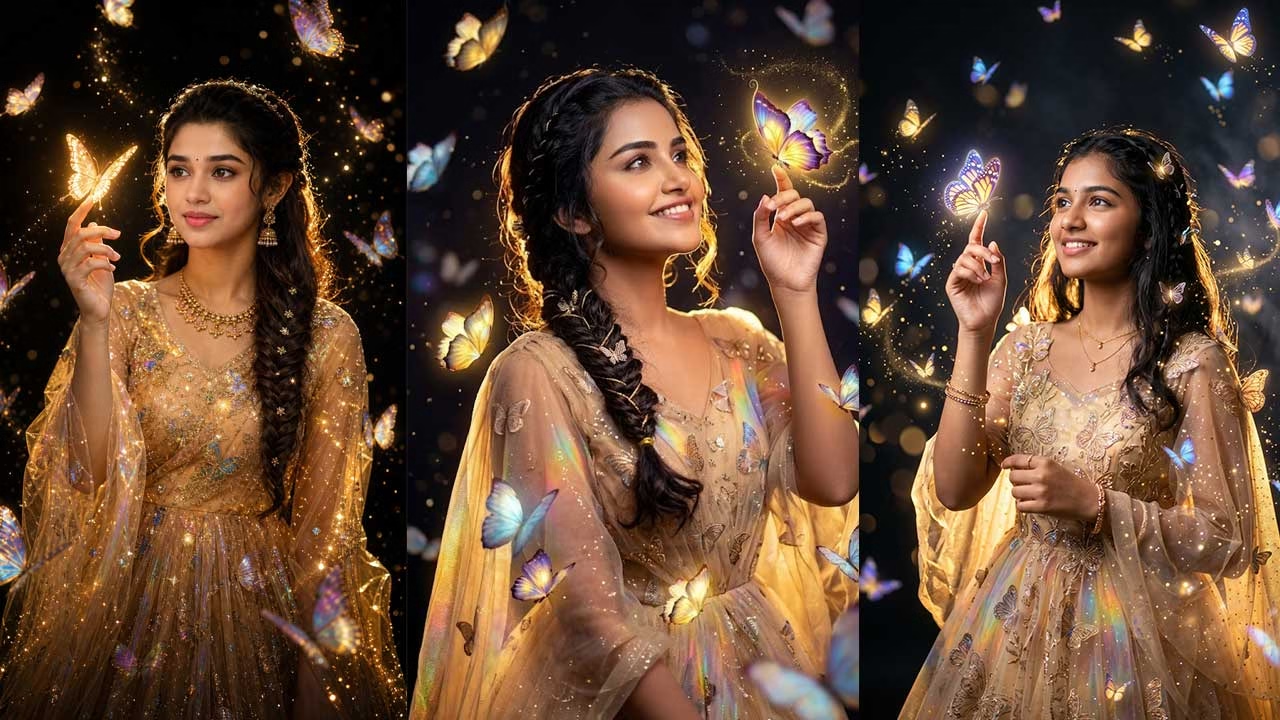
A magical cinematic portrait of the same person from the uploaded photo, strictly preserving the exact face, identity, and head angle (slightly turned upward, soft smile). The facial features, skin tone, and expression must remain unchanged and realistic.
She is raising her hand gracefully in the same position, with a glowing butterfly sitting gently on the tip of her index finger (important: butterfly must be touching the finger, not floating away).
Surround her with multiple luminous butterflies (gold, blue, purple tones) flying around in depth — some close, some far with soft blur. Add sparkling golden particles, light dust, and magical glowing trails.
Outfit transforms into a luxurious, semi-transparent, fairy-like gown in warm golden tones with subtle rainbow reflections. The dress should have embedded butterfly patterns, glittering details, and soft flowing fabric with shimmer highlights.
Lighting:
– strong warm golden rim light from behind to create glowing edges
– soft front light to keep face natural and detailed
– butterfly glow casting subtle light on fingers and face
– cinematic contrast with dreamy bloom effect
Background must be deep black with soft bokeh particles and magical haze.
Camera & Quality:
85mm portrait lens look, shallow depth of field, sharp focus on face, soft bokeh background, ultra-realistic, 4K, HDR, highly detailed, cinematic color grading.
Aspect ratio: 9:16 vertical portrait
Important:
no face distortion, no face change, no angle change, preserve exact likeness, correct hand anatomy
blurry face, distorted face, different face, wrong angle, extra fingers, bad hands, floating butterfly not touching finger, cartoon, low quality, overexposed skin.
The Future: Identity-as-a-Service in Generative Media
As generative systems continue to evolve, the concept of Identity-as-a-Service is emerging as a foundational paradigm in digital creativity. In this model, an individual’s visual identity becomes a reusable, secure asset that can be rendered across multiple styles, environments, and narratives without losing authenticity. By combining advanced prompt engineering, robust observability systems, and authenticity frameworks like C2PA, the future of digital portraiture will not only enhance artistic expression but also redefine how identity is preserved, protected, and experienced in an increasingly synthetic visual world.