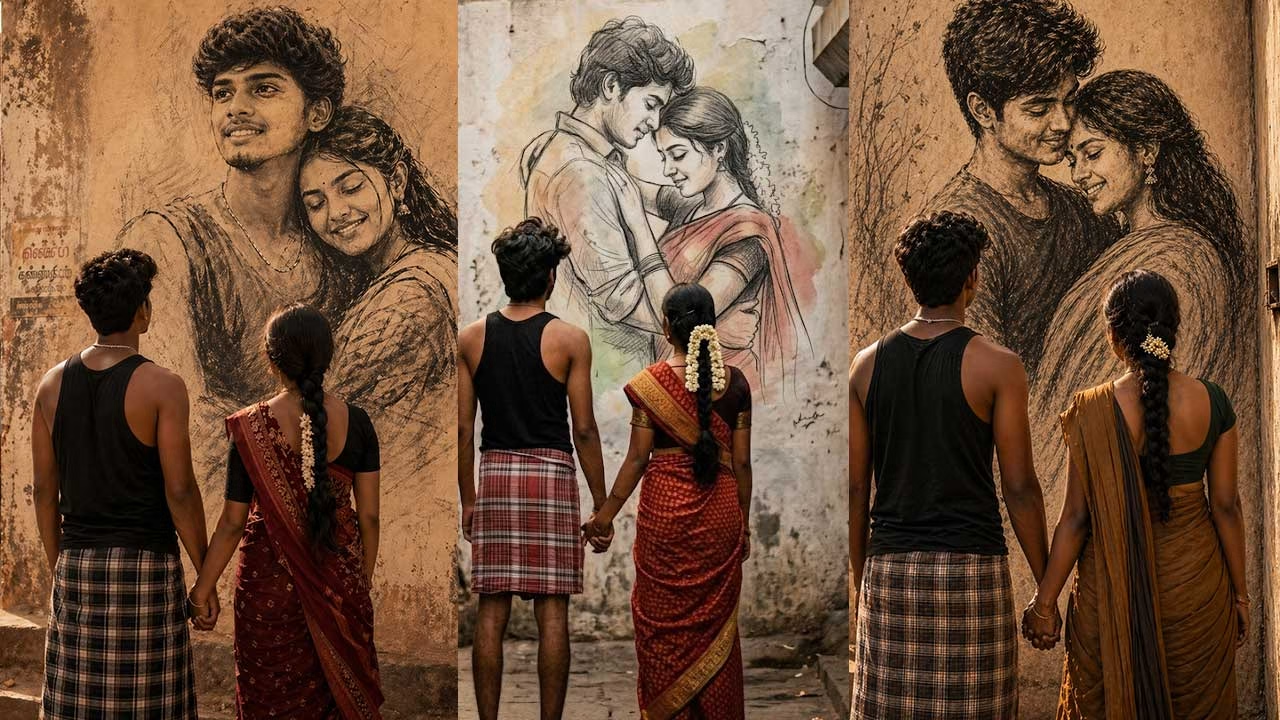
There’s a specific kind of warmth that doesn’t just sit in an image—it lingers in you. The frame opens in that golden hesitation between evening and night, where shadows stretch and everything feels slower. The couple stands quietly, not posing, not performing—just existing in that suspended moment. This is where the image earns its weight. It doesn’t try to impress; it tries to remember.
The Problem With “Rural” in AI
Most models don’t understand rural South India—they approximate it. The result is often a collage of clichés: overly saturated greens, artificial smiles, and clothing that looks designed rather than lived in. In my early tests, the alley felt staged, the people felt like actors, and the entire frame carried the subtle dishonesty of stock imagery. The issue wasn’t technical limitation. It was the absence of cultural nuance.
The Weight of the Lungi: Why Texture Matters
The checked lungi became a quiet test of authenticity. AI tends to either over-perfect patterns or dissolve them into noise. Neither feels real. What worked was insisting on imperfection—slight misalignment in checks, natural folds that respond to gravity, fabric that doesn’t shine unless light insists on it. That’s when the lungi stopped being a pattern and started becoming clothing.
Saree, Not Costume
The saree needed restraint. Too often, models inflate it into spectacle—high contrast, glossy highlights, unnecessary drama. But rural elegance doesn’t announce itself. It sits in muted tones, practical draping, and the absence of excess. The braid, too, had to be grounded—tight, functional, slightly imperfect. Not styled for a frame, but for a day.
The Anatomy of Golden Hour
Lighting carried the emotional weight of the entire composition. Without it, everything felt assembled. With it, everything belonged. The golden hour here isn’t decorative—it’s connective. It softens textures, merges tones, and reduces visual noise. It allows the scene to breathe. I treated it less like an effect and more like a condition—something the entire image had to obey.
When Depth of Field Becomes Memory
Shallow depth of field can easily become a gimmick, but here it needed discipline. The couple holds clarity—not sharpness for its own sake, but enough presence to feel physically grounded. The mural sits just beyond that clarity, slightly softened, like something remembered rather than seen. That subtle separation creates emotional layering without forcing it.
The Impossible Bridge: 3D Meets 2D
The real challenge was convincing the model to respect difference. The couple exists in volume—light wraps around them, fabric reacts, skin holds texture. The mural exists in suggestion—pencil strokes, soft shading, edges that dissolve into the wall. Without strict guidance, the model collapses these into one style. The success of the image depends on maintaining that boundary without making it obvious.
Meta-Art and Emotional Echo
The mural isn’t just a visual element—it’s a reflection that doesn’t quite belong to the present. The couple stands before a version of themselves that is softer, more intimate, almost imagined. This creates a quiet loop: are they looking at memory, or possibility? That ambiguity is where the image holds you.
Telugu Script: Where Precision Matters
Text is often where immersion breaks. Telugu script, in particular, exposes the limits of most models. It tends to distort, merge, or lose structure entirely. Forcing exact text rarely works. Guiding the style does. When the lettering feels hand-drawn, slightly imperfect, and integrated into the wall, it stops being something to read and becomes something to feel.
Walls That Carry Time
The alley walls needed age, but not exaggeration. AI often confuses “old” with “destroyed.” What I wanted was lived texture—faded paint, subtle cracks, layers of time without drama. The wall had to feel like it had watched years pass, not survived a catastrophe. That distinction changes the entire mood of the frame.
Why Most Prompts Collapse Here
Generic prompts leave too many gaps, and AI fills those gaps with assumptions. That’s where stereotypes enter. This prompt works because it removes ambiguity where it matters—attire, lighting, material behavior—while allowing space where emotion lives. It’s less about controlling the image and more about protecting it from misinterpretation.
The Role of Stillness
Nothing moves in the frame, yet nothing feels frozen. That balance comes from intention. By placing the couple from behind, holding hands, the image avoids performance. There are no expressions to interpret, no gestures to decode. Just presence. Stillness, in this case, becomes narrative.
When the Image Finally Settles
After multiple iterations, the moment it worked was almost quiet. Nothing stood out as “impressive.” The light felt natural, the textures behaved, the mural held emotion without dominating. The image didn’t demand attention—it held it gently.
What stayed with me after all the iterations wasn’t just the image, but the language that made it possible. The prompt itself became a kind of blueprint—not just for visuals, but for restraint, texture, and memory. This is the exact structure that finally held everything together:
Prompt:
A cinematic, emotional street scene in a narrow Indian alley with warm golden lighting. In the foreground, a young South Indian couple stands holding hands, seen from behind. The man wears a black sleeveless vest and a checked lungi, with a lean physique and slightly messy hair. The woman wears a traditional saree with a blouse, her hair neatly braided, conveying a simple, rural elegance. They are both looking at a large, artistic wall mural in front of them. The mural is a hand-drawn sketch-style illustration of the same couple embracing each other lovingly, with expressive pencil strokes and soft shading, capturing deep emotion and intimacy. The mural appears slightly faded and textured, blending into the aged wall surface. Above the mural, Telugu text is written in a stylish, artistic font. The environment has a rustic, earthy tone with soft shadows, warm highlights, and a nostalgic atmosphere. The alley walls are worn and textured, adding realism.
Style & Quality: Ultra-realistic, 8K resolution, cinematic composition, shallow depth of field, soft warm color grading, dramatic lighting, highly detailed textures, emotional storytelling, volumetric light rays. Aspect Ratio: 4:5 vertical
What Stayed With Me After
This process wasn’t about pushing AI to create something extraordinary. It was about asking it to respect something ordinary without reducing it. The difference is subtle, but it changes everything. When the machine stops exaggerating and starts observing, even imperfectly, the result begins to feel less like generation and more like recall.