
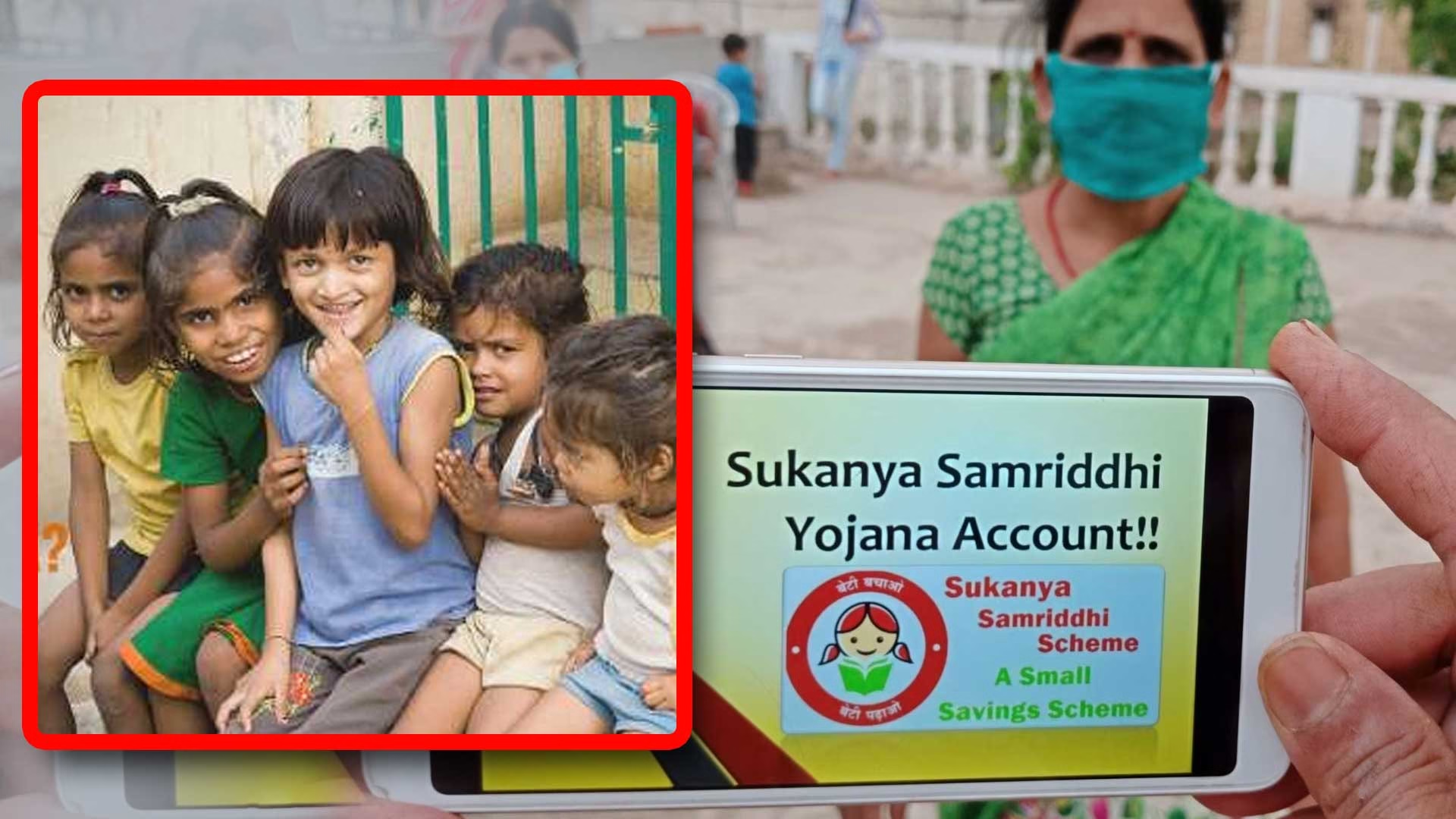
She held the scrap of paper in her hand, her eyes reflecting a hope she couldn’t quite voice—but she imagined one day handing a secure future to her daughter. That instinctive longing is what the Sukanya Samriddhi Yojana seeks to harness in every parent’s heart.
Genesis and Underlying Purpose
When the Government of India launched Sukanya Samriddhi Yojana in January 2015 under the Beti Bachao, Beti Padhao campaign, its aim was not just financial inclusion but social transformation. The scheme deliberately encourages parents or guardians to save early for a girl child’s future education and marriage. It is a long-term, government-backed investment tool designed uniquely for daughters, blending commitment with flexibility.
Who Can Open an Account
Only a girl child who is an Indian citizen can benefit from this scheme. The account must be opened before she turns ten, though there is a nominal one-year grace in exceptional cases. The responsibility to open and operate the account lies with her parents or legal guardian. In typical situations, a family may have up to two such accounts, but in case of twins or triplets, a third account may be permitted under special medical certification.
Initial and Annual Contributions
The scheme permits annual deposits beginning from as low as ₹ 250, up to a limit of ₹ 1.5 lakh in a financial year. The deposits can be split across multiple installments, but must comply with the minimum threshold to maintain the account’s active status. If the minimum deposit is missed in a year, the account becomes “in default,” and a fine must be paid to revive it—though funds already deposited continue to earn interest.
Interest Rate and Its Calculation
One of the scheme’s strongest attractions is the attractive interest offered, which changes quarterly as set by the Ministry of Finance. For example, in mid-2025 the rate stood at 8.2% per annum. The interest is compounded annually and is computed on the lowest balance between the fifth day and the end of every month. Because interest is calculated yearly, small timing differences in deposit can impact returns subtly.
Deposit Duration and Maturity Protocols
Although you can contribute only for the first 15 years, the account remains active for 21 years from its opening. On maturity, the account balance along with accrued interest is paid out to the girl child. If she marries after attaining the age of 18, she may choose to close it early, subject to conditions. But ordinarily the full benefit is accessible only at the 21-year mark.
Premature Withdrawals and Conditions
The scheme allows for partial withdrawal after the girl attains 18 years of age or completes class 10, whichever is earlier. This withdrawal is capped at 50 percent of the balance at the close of the preceding financial year. These funds can be used for higher education or marriage expenses. However, such withdrawal is subject to furnishing proof like admission offers, expense receipts, etc.
Closure Under Special Circumstances
Closure of the account before maturity is permitted only under certain strict conditions. If the girl or her guardian passes away, the account is closed and the balance plus interest is paid out. If the girl marries before maturity but after 18, closure is allowed within a defined time window. Also, if she becomes non-resident or loses Indian citizenship status, the account is deemed closed.
Transferability Across India
One of the useful features of this scheme is that the account can be transferred freely across post offices and banks in India. If a family relocates, they can shift the account to a convenient branch without affecting the continuity of interest or compliance. Such transfers help maintain flexibility despite changing life circumstances.
Tax Incentives and Exemptions
Sukanya Samriddhi Yojana enjoys the much-sought “Exempt-Exempt-Exempt” (EEE) status. Contributions under the scheme qualify for deductions under Section 80C of the Income Tax Act (up to applicable limits). The interest earned is exempt from tax, and the maturity amount is also tax-free. This triple benefit makes the scheme financially efficient and attractive to many investors.
What Happens If Minimum Deposit Is Missed?
If the required minimum deposit in a year is not made, the account is classified as “in default.” To regularize it, the account holder must pay the missed amount plus a penalty (typically ₹50 per year). Even while in default, any deposit already made continues to accrue interest. However, further accumulation and full benefit require revival before maturity.
Comparative Attractiveness Among Schemes
In a market crowded with various savings options, SSY stands out because of its government guarantee, tax benefits, and specialized motive for a girl child’s welfare. Unlike many fixed-deposit products, the interest rate is periodically adjusted, and unlike many long-term plans, partial liquidity for education is built in. Its exclusivity for girl children gives it social dimension too.
Check Scheme
Possible Limitations and Critiques
Every scheme has trade-offs, and SSY is no exception. The long lock-in means funds are largely illiquid for two decades. The rate resets each quarter, so future interest risk lies with the government. Some critics also point out that the cap on number of accounts doesn’t address families with more daughters born over time — exceptions are rare and tightly regulated.